High-speed navigation in the northwest Mediterranean remains unchanged despite international recommendations to avoid ship collisions with whales
- Informations
- Download
- 3 autres contenus médias
Ship speeds remain unchanged in Mediterranean whale protection zone despite IMO recommendations. New analysis shows 57% of the total distance travelled was at speeds above 10 knots.
PRESS RELEASE – 2 October 2025
High-speed navigation in the northwest Mediterranean remains unchanged despite international recommendations to avoid ship collisions with whales
A comparative analysis of maritime traffic data for 2023 and 2024 highlights the need to establish mandatory speed limits to protect endangered whales.
- Excessive vessel speed is the greatest threat to whales in the north-western Mediterranean, where the Cetacean Migration Corridor is located.
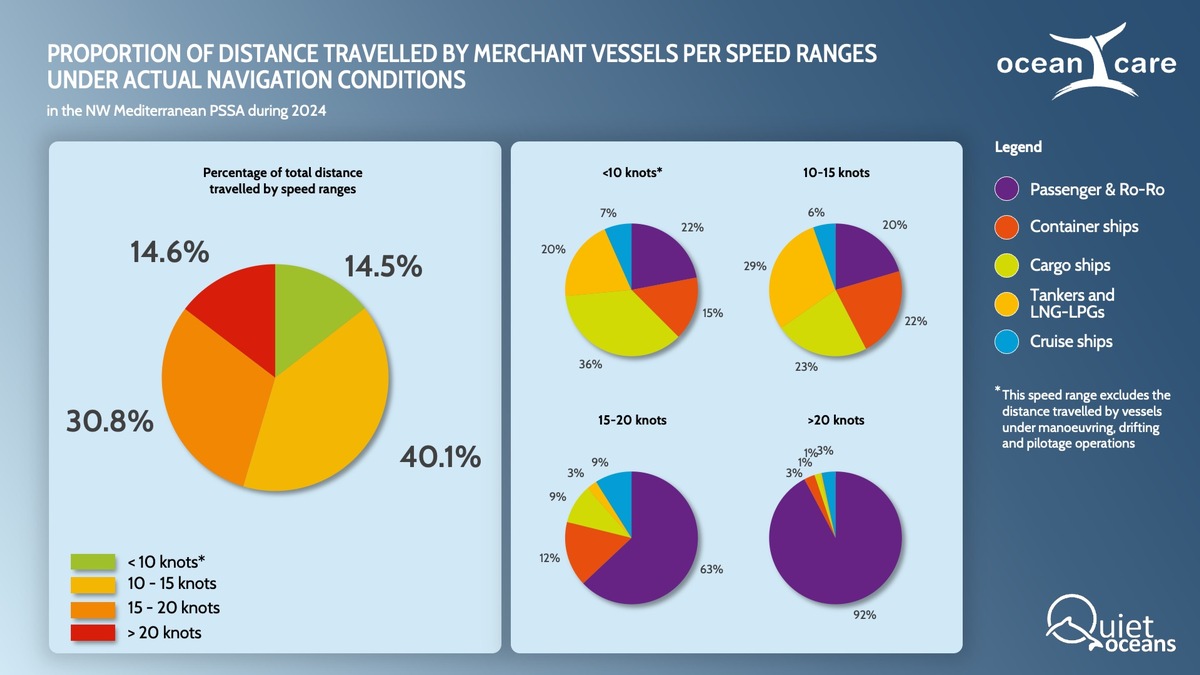
- More than 80% of the distance travelled by the six main categories of merchant ships in the area in 2023 and 2024 was at speeds of over 10 knots, posing a lethal risk to whales in the event of a collision.
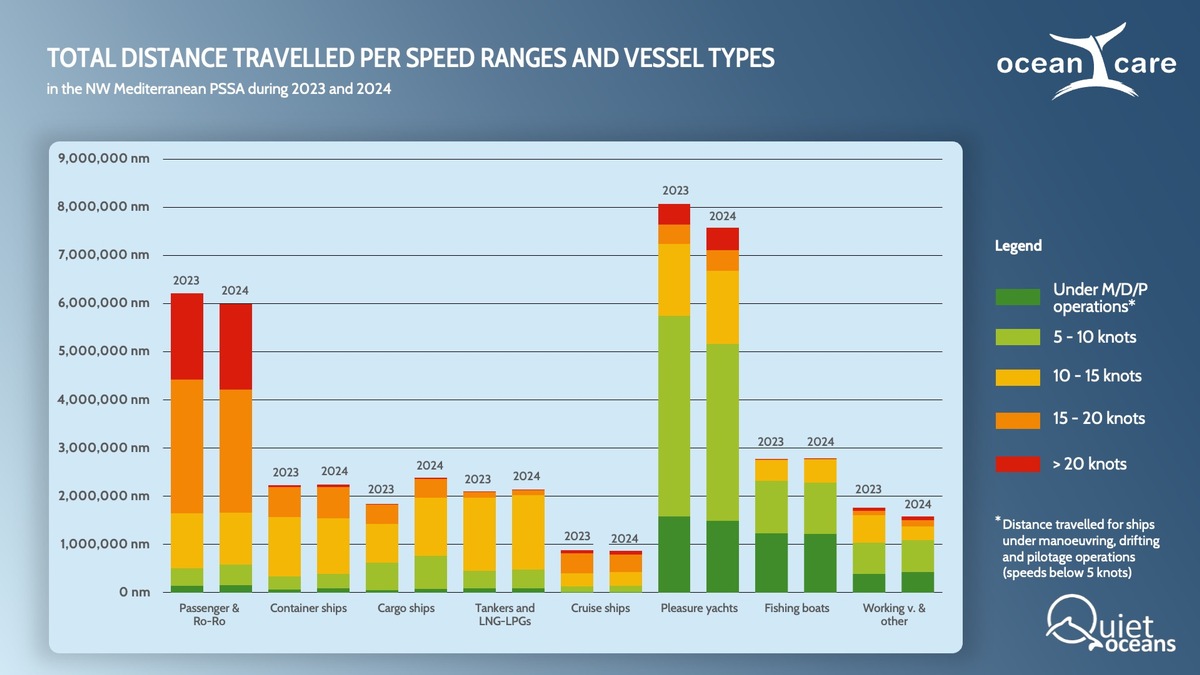
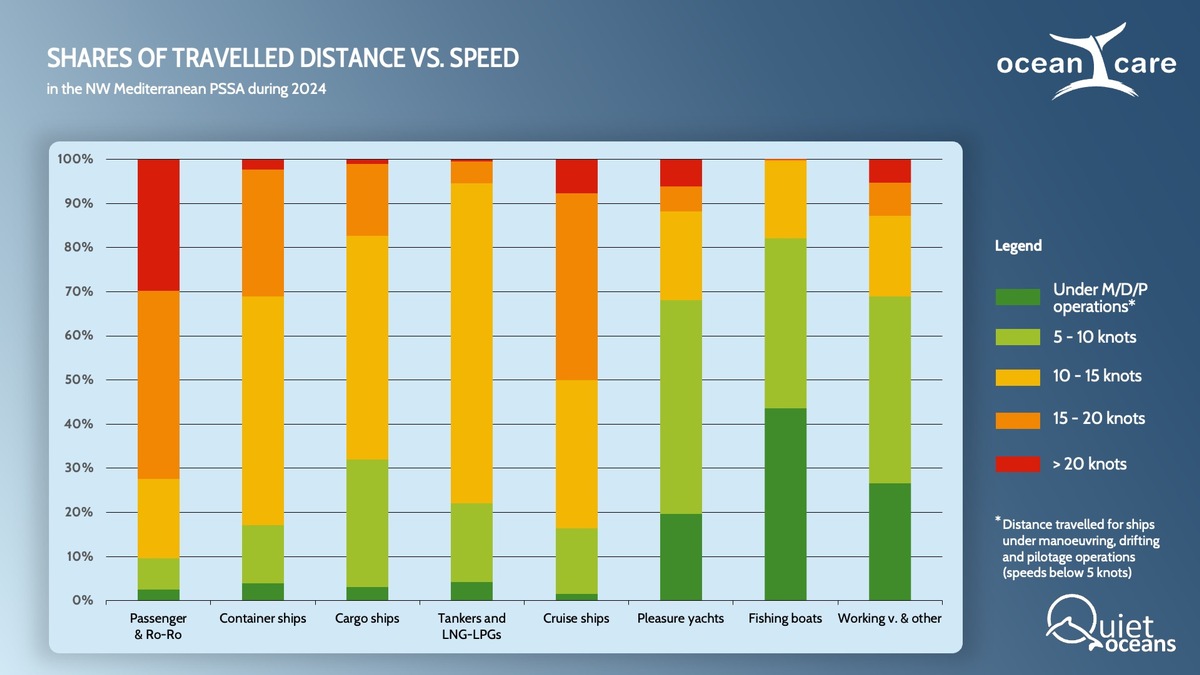
- Ferries, with a total of more than 11 million kilometres sailed in 2024, travelled 90.4% of that distance at speeds above 10 knots, 72.4% at more than 15 knots and almost 30% at more than 20 knots.
Madrid, Spain – OceanCare, together with Alnitak, Bluewave Alliance, ClientEarth, Ecologistas en Acción, Greenpeace, GOB Mallorca, Fundación Marilles and WWF, presented the findings of a new analysis at a press conference in Madrid, showing that voluntary vessel speed reduction measures are failing to protect endangered whales in the north-western Mediterranean.
Collisions with ships are the main cause of human-induced death for large whales in the north-western Mediterranean, notably the fin whale and the sperm whale, both classified as ‘endangered’ by the International Union for Conservation of Nature (IUCN).
In order to address this serious problem and reduce the risk of fatal collisions, in 2023 the International Maritime Organisation (IMO) approved the designation of this area as a Particularly Sensitive Sea Area (PSSA) and established a voluntary measure to reduce ship speeds to 10-13 knots. The best available scientific data indicate that the probability of a collision having a lethal effect on a whale is very low when the ship's speed does not exceed 10 knots.
The Cetacean Migration Corridor is located in the northwestern Mediterranean PSSA. This area of high ecological value was designated by Spain in 2018 as a Marine Protected Area (MPA) and as a Specially Protected Area of Mediterranean Importance (SPAMI) by the United Nations Barcelona Convention in 2019.
Despite the IMO's declaration of this PSSA, a comparative analysis of data on the distance travelled by ships – according to different speed ranges – during their transit through the area in 2023 and 2024, leads to the conclusion that shipping companies are not incorporating the IMO's recommendations to reduce speed in this area. Therefore, there remains a serious risk of collisions between ships and large whales (fin whales and sperm whales), with lethal consequences for the latter.
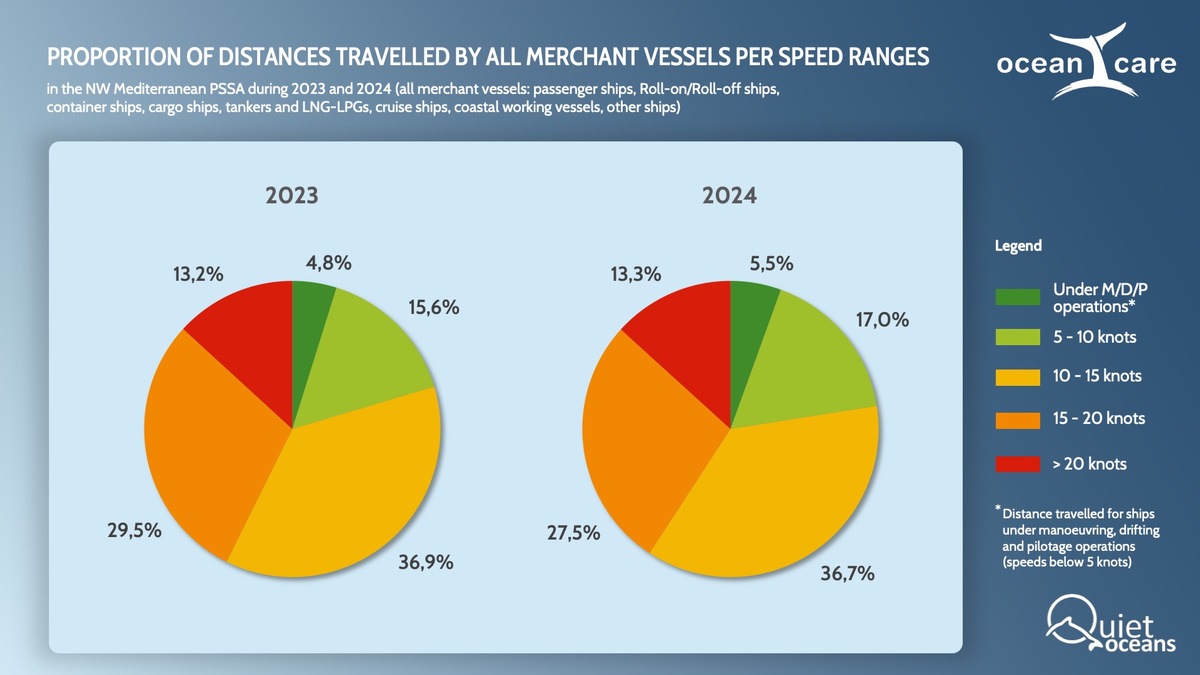
According to the data from the analysis – carried out by Quiet Oceans and commissioned by OceanCare – the overall navigation behaviour of ships, especially in terms of average speeds, remained stable in both years. Of the nearly 48 million kilometres travelled by all ships sailing in the waters of this PSSA in 2023 and 2024, 57% of the total distance travelled was at speeds above 10 knots, with no significant variations between the two years (56.9% in 2023 and 57.5% in 2024).
In the case of the six main categories of merchant ships, more than 80% of the total distance travelled (equivalent to more than 25 million kilometres) was at speeds above 10 knots (84.8% in 2023 and 82.8% in 2024). Focusing on ferries – both passenger and roll-on/roll-off (Ro-Ro) – this proportion exceeded 90% in both years. Ferries are the vessels that travel the longest distances at high speeds, making them a significant source of both underwater noise and collision risk.
Carlos Bravo, OceanCare’s spokesperson and Head of Marine Policy in Spain said at the press conference:
“The data is undeniable and shows that voluntary speed reduction recommendations are not sufficient to protect endangered whales. The northwestern Mediterranean PSSA and the Mediterranean Cetacean Migration Corridor MPA represent a historic opportunity for these protection measures to become a reality and not remain a mere declaration of intent. The next logical step would be to make them mandatory, which would provide the necessary legal certainty and a level playing field for the sector to continue operating without threatening the lives of these large mammals."
Nicolas Entrup, Director of International Relations at OceanCare added:
"The North-West Mediterranean Sea could become a shining example for managing shipping in support of whale conservation. But, so far, no such action has been taken and no change in vessel speed has occurred, which would be the only way to reduce the risk of ship strikes. It is obvious that we need to speed up to slow down vessel speed, if fin whales and sperm whales are to thrive in this region in the future."
Reducing ship speed has multiple positive effects on the environment: in addition to reducing the risk of fatal collisions with whales and underwater noise, it significantly reduces CO2 emissions, as well as atmospheric pollutants such as sulphur oxides (SOx), nitrogen oxides (NOx), particulate matter and black carbon, with immediate effect and at minimal cost.
On behalf of the coalition of environmental organisations, the group emphasised: "The Spanish government must approve a management plan that effectively regulates human activities that threaten the Mediterranean Cetacean Migration Corridor MPA, which aims to safeguard critical habitats for endangered species such as the fin whale and the sperm whale.” Although the process is already underway and the plan is scheduled for publication in June 2026, it is several years behind schedule.
The Ministry for Ecological Transition and Demographic Challenge (MITECO), in coordination with the Ministry of Transport and Sustainable Mobility (MITMS), is leading its development through a participatory process with civil society. The coalition of several environmental organisations – including Alnitak, Bluewave Alliance, ClientEarth, Ecologistas en Acción, Greenpeace, GOB Mallorca, Fundación Marilles, Mission Blue, Oceana, OceanCare, Save The Med and WWF – is calling for the inclusion of a mandatory reduction in vessel speed throughout the MPA/ZEPIM as an urgent measure to reduce collisions and underwater noise.
Specifically, the following measures are requested: The enforcement of a general speed limit of 10 knots for all types of vessels, including recreational ones, that travel within the Cetacean Migration Corridor’s boundaries.
Exceptions to this 10-knot speed limit would be:
a. The development of a Traffic Separation Scheme (TSS) based on relevant scientific research. Merchant vessels will be obliged to navigate within the TSS at a reduced speed compared to their usual operational speed. The specific percentage reduction for each category of ships will be determined on the basis of the relevant scientific and technical studies.
b. The establishment of a mandatory speed reduction for ferries operating in public service and already adhering to predetermined routes. This reduction should be determined by thorough scientific studies, with the objective of minimising the risk of collisions as much as possible, while ensuring that the quality of their service is not affected.
To date, a petition has been endorsed by 60 people from the scientific and legal fields and was delivered to the Vice-President and Minister for Ecological Transition and Demographic Challenge, Sara Aagesen, during the UN Ocean Conference (UNOC3) in June 2025.
At this meeting, Vice-President Aagesen confirmed her commitment to establishing measures to reduce the speed of vessels in the aforementioned MPA/SPAMI. A joint working group has also been set up between MITECO, MITMS, economic sectors and NGOs to specify the speed reduction measures.
The organisations are confident that this mechanism will enable balanced solutions to be reached that reconcile environmental protection with the needs of maritime transport. Its first and only meeting to date took place on 26 May in Madrid. The aforementioned entities have called for the urgent reactivation of this working group.
ENDS
Media contact
- Carlos Bravo, Lead of Marine Policy in Spain at OceanCare, +34 626 998 241, cbravovilla@oceancare.org
Image material
- Distribution of distance travelled in real navigation conditions across different speed ranges by merchant ship type
- Proportion of distances travelled by all merchant vessels per speed ranges – Comparison 2023 and 2024
- Total distance travelled per speed ranges and vessel comparison 2023 and 2024
- Proportion of distance travelled by merchant vessels per speed ranges under actual navigation 2024
- Download all images
About OceanCare
OceanCare is an international marine conservation non-governmental organisation, founded in Switzerland in 1989. The organisation pursues the protection and restoration of the marine environment and marine wildlife with a strong policy focus, combining research, conservation projects and education. OceanCare’s remit includes marine pollution, climate change, marine mammal hunting and the environmental consequences of fisheries. Its work is supported by a team of scientific, legal and policy experts, and involves strategic collaboration with civil society organisations and coalitions around the world. OceanCare is an officially accredited partner and observer to several UN conventions and other international fora. www.oceancare.org
About Quiet-Oceans
Quiet-Oceans is a company specialising in the assessment of risks to marine biodiversity, particularly underwater noise and ship collisions with whales caused by maritime traffic. Quiet-Oceans has developed OceanPlanner©, a web-based service that facilitates decision-making regarding the combined issues of ship strikes with whales, underwater noise from vessels, and greenhouse gas emissions from maritime traffic. The tool provides a concrete assessment of the current situation and the main characteristics of shipping traffic. It identifies where and when the best measures should be prioritized and provides information for national and regional roadmaps for protecting the marine environment. It demonstrates both the economic impacts and environmental benefits of each regulatory scenario. www.quiet-oceans.com
--
OceanCare
Gerbestrasse 6
CH-8820 Waedenswil - Switzerland
www.oceancare.org