New scientific critique of the Faroe Island pilot whale hunt
- Bild-Infos
- Download
- Ein weiterer Medieninhalt
Cruel from start to finish – concludes new scientific critique of the Faroe Island pilot whale hunt.
PRESS RELEASE – Embargo: 00.05 (GMT) 05 November 2025
The new welfare assessment published in a leading scientific journal confirms that it is impossible for Faroe Island pilot whale hunts as conducted to be carried out humanely.
Waedenswil, Switzerland – A new study by animal welfare experts published today in the prestigious journal Biology Letters highlights the negative impacts on pilot whales hunted in the Faroe Islands and disproves the claim from the authorities in the Faroes that the hunt is swift and efficient.
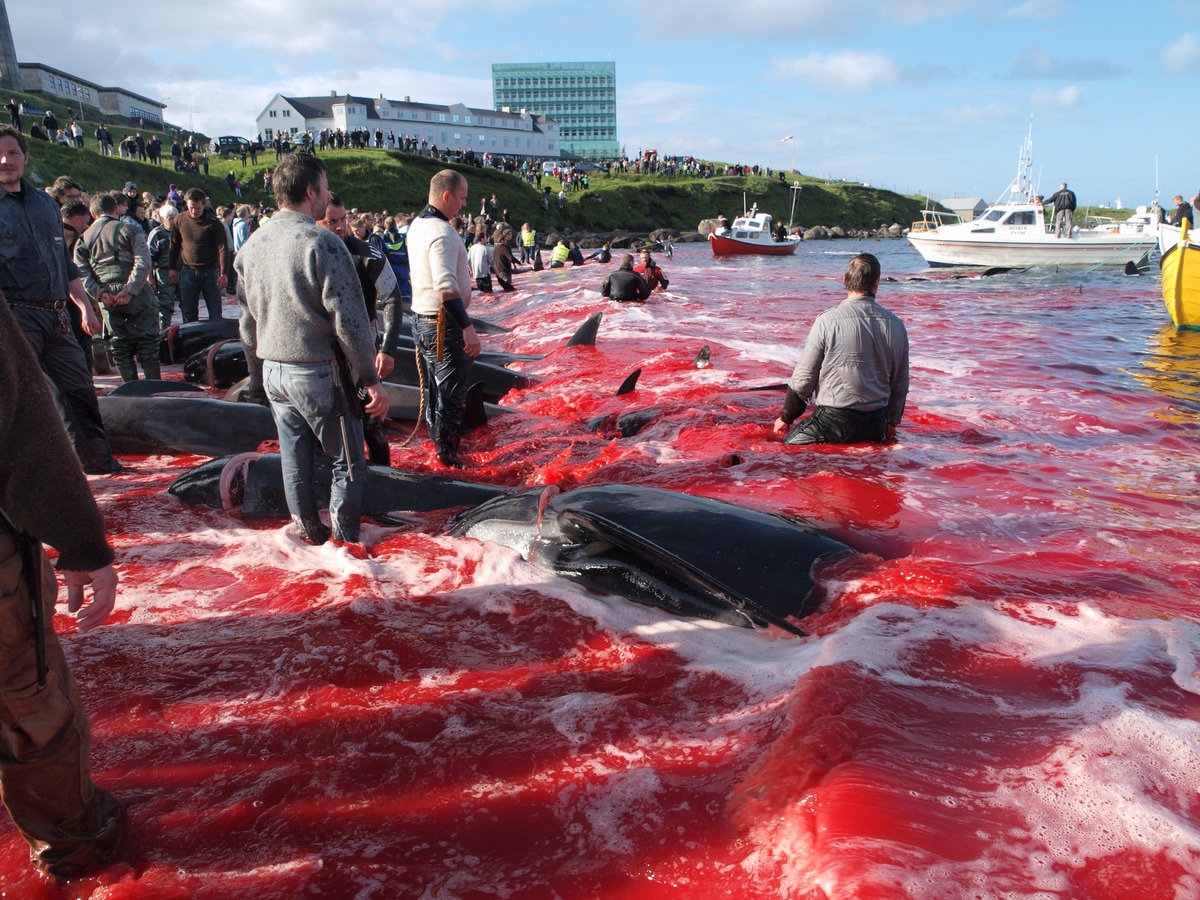
The study describes the various stages of the hunt, from the driving of the whales to the forced stranding on the beach, the capture and restraint of the animals using hooks and ropes, and the final killing with specific tools. The authors assessed how each stage of the hunt would likely impact the welfare of the individual animals. At each stage there were negative impacts – some of them extremely concerning.
During the drive, which involves chasing the animals with boats and other motorised watercraft, the cetaceans likely experience acute and chronic physiological stress responses which have various negative impacts including pain. The chase can disrupt the social group, for example separating dependent calves from their mothers.
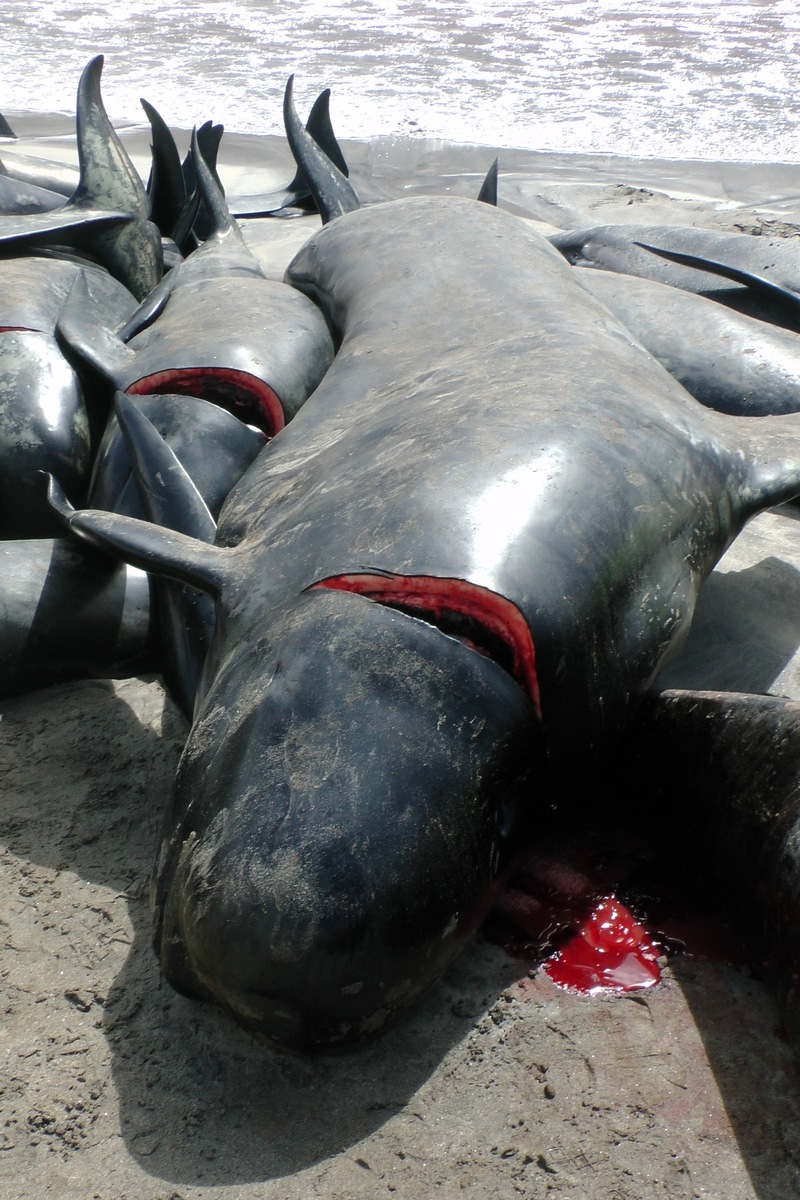
Once the whales are forced to strand, their internal organs are compressed because they are no longer supported by water. This likely causes breathlessness as they are unable to breathe properly and the damage to their internal organs is likely to be painful. Their skin is supposed to be in the water all the time and can quickly dry and blister when they are on land. They may be wounded if they strand on rocks or other uneven terrain. Their body temperature may also overheat. In cases where many whales are stranded at once, it may take some time before the hunters can kill all the animals. The last ones to be killed will have spent a considerable time suffering from the impacts of the stranding.
To drag the pilot whales into shallow water and to hold them in place, the hunters put a hook in the whale’s blowhole and pull on a rope attached to the hook. The whales breathe through their blowhole and need to be able to close it to prevent water from getting in. The hook likely prevents these two key functions and may cause pain and distress to the animals.
Once the whale is held in place, one of the hunters uses a tool called a spinal lance to sever the spinal cord and associated blood vessels. However, if the aim is to make the animal instantly and irreversibly unconscious, the brainstem must be disrupted or the blood supply immediately cut off and there is no current evidence that the spinal lance consistently does this. It seems likely that many animals will still have a sufficient blood supply to the brain to remain conscious. The Faroese hunters are supposed to check whether the animal is conscious by touching its eye to see if there is a reflex. Video evidence suggests that many hunters do not carry out this check meaning that some animals are likely conscious and aware of what is happening during the killing process. Therefore, when the final part of the process takes place – a deep cut into the neck with a whaling knife - some animals are probably at least partially conscious.
Although the authors recognised that attempts have been made in recent years to improve the hunt in terms of how the animals are handled and killed, the nature of the hunt means that the whales’ welfare is impacted negatively over a considerable period of time with the potential to cause a number of negative welfare outcomes including anxiety, breathlessness, confusion, disorientation, dizziness, helplessness, fear, panic, pain, discomfort, fatigue and weakness.
Mark Simmonds, one of the authors of the study and Director of Science at OceanCare stated:
“OceanCare has been concerned about the cruelty of Grindadráp (the pilot whale hunt that takes place in the Faroe Islands) for many years. This new full assessment of the impacts of the hunt shines a light on how cruel it is at each stage and utilised the Five Domains Model, the gold standard in welfare science. It may be that the cruelty of the hunt has not been fully recognised in Faroese society and so we hope that this paper will help people in the island to better understand the severe welfare issues that the hunt raises.”
Laetitia Nunny , another of the authors of the study and Senior Science Officer at OceanCare explained:
“Pilot whales live in tight knit family groups. To stay safe in the open ocean, their pods are extremely important to them, and they never abandon one another. This means that when they are driven towards the shore by the hunters, they stick closely together. It must be extremely stressful, even traumatic, for them when they realise that there is no escape and when they have to witness their family members being killed around them.
“As we learn more and more about different species of whales and dolphins, we are finding that they are clearly sentient animals, many with unique cultures. We know that they can think and feel, and it is, therefore, unjustifiable to kill them in such an inhumane manner.”
ENDS
Media contact
- Nicolas Entrup, Director of International Relations, OceanCare, M. + 43 660 211 9963, nentrup@oceancare.org
Notes to editors
The annual number of animals killed is highly variable but around 700 pilot whales have been taken each year recently. The dolphin take, with the exception of 2021 (when some 1,400 were killed in a single hunt), is usually in the low hundreds or sometimes none at all).
Recorded hunts since this summer in the Faroes (numbers are unofficial estimates at this time):
June 12, 2025, over 246 pilot whales (may be as high as 296 based on photo evidence) killed in Leynar
July 5, 2025, 49 pilot whales killed in Bø
July 20, 2025, 116 pilot whales killed in Tjørnuvík
Aug. 25, 2025, 50 Atlantic white-sided dolphins killed in Skálafjörður
Aug. 26, 2025, 30+ pilot whales killed in Sandagerði (Torshavn)
Aug. 30, 2025, 29 pilot whales killed in Hvalba
Publication
Simmons AG, Boys RM, Nunny L, Simmonds MP. 2025 An assessment of cetacean welfare in the Faroe Islands’ drive hunt. Biology Letters 21: 20250311.
Presentation
Co-author Alick Simmons will present and discuss the findings in a research webinar on Friday, November 7, 2025, 3:00–3:30 PM (GMT+1). https://cassyni.com/events/Wpz5v4kjyFJugL7yuMzYKf
About OceanCare
OceanCare is an international marine conservation non-governmental organisation, founded in Switzerland in 1989. The organisation pursues the protection and restoration of the marine environment and marine wildlife with a strong policy focus, combining research, conservation projects and education. OceanCare’s remit includes marine pollution, climate change, marine mammal hunting and the environmental consequences of fisheries. Its work is supported by a team of scientific, legal and policy experts, and involves strategic collaboration with civil society organisations and coalitions around the world. OceanCare is an officially accredited partner and observer to several UN conventions and other international fora.  www.oceancare.org

--
OceanCare
Gerbestrasse 6
CH-8820 Waedenswil - Switzerland
www.oceancare.org