Carbon Budget of Mediterranean Exceeded by 2035
- Bild-Infos
- Download
Carbon Budget of Mediterranean Exceeded by 2035: Annual Cuts of 6% Needed, New Study Warns
PRESS RELEASE – 15 October 2025
A new report from the Basque Centre for Climate Change (BC3) for OceanCare shows urgent action is needed to stay within the Mediterranean’s carbon budget.
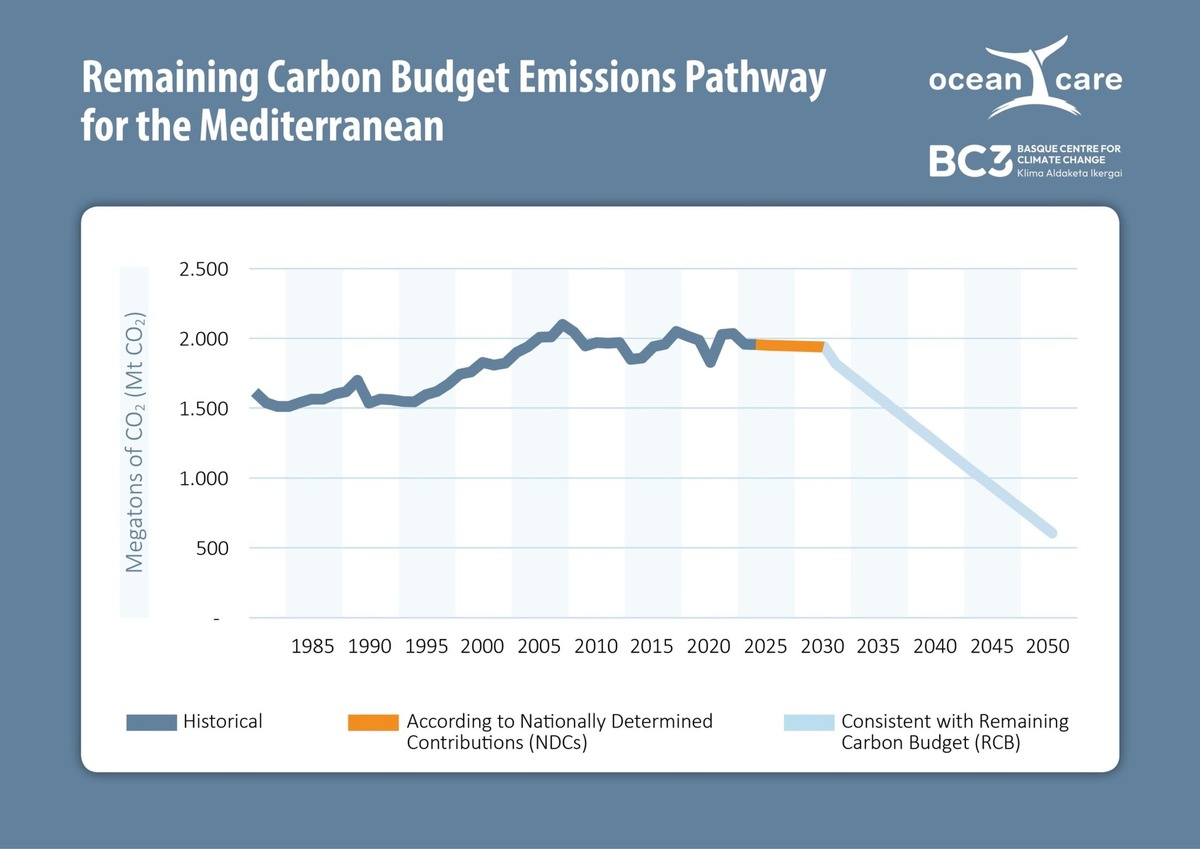
Madrid, Spain – The Mediterranean Region is on track to exhaust its remaining carbon budget by 2035, according to a new report from the Basque Centre for Climate Change (BC3), prepared for OceanCare. Unless countries reduce emissions by around 6% per year between 2030 and 2050, the region will overshoot the Paris Agreement goals, putting both communities and ecosystems at escalating risk.
The study analyses carbon budget allocation and emission pathways for the 21 signatory countries of the Barcelona Convention, as the region faces accelerating warming. Data from the Mediterranean Centre for Environmental Studies (CEAM, 2024) shows that the surface temperature of the Mediterranean Sea has risen by 1.5°C over the past 40 years, threatening climate stability and the wellbeing of all life in the region.
“Science offers a frightening outlook for the Mediterranean area as a result of climate change. Unfortunately, despite the overwhelming evidence on the disproportionate impact of climate change in the Mediterranean, most range states are not taking a lead in decarbonisation efforts”, says Carlos Bravo, Oceans Policy Specialist at OceanCare.
"Keeping the Mediterranean below 1.5 °C is an impossible mission; that opportunity has already passed. But the decarbonisation target to stay within the 2 °C limit is still possible and is an obligation under the Paris Agreement. Mediterranean countries must be consistent with the agreement reached at COP28 of the UNFCCC and begin the “transition away from fossil fuels” in a fair, orderly and equitable manner, marking the “beginning of the end” of the fossil fuel era,’ added Carlos Bravo of OceanCare.
“The time when the ecological transition could be envisaged as a gradual change is now over, as the results of this study show. The climate procrastination of states means we must either accelerate the transition or face the consequences of climate chaos,” says Dr María Victoria Román, Lead Author at BC3.
The report evaluates alternative approaches for distributing the remaining carbon budget (RCB) and projects emissions pathways from 2030 to 2100, based on countries’ Nationally Determined Contributions (NDCs) and using the Integrated Assessment Model GCAM.
Key findings:
- All countries must accelerate emission reductions from 2030, with the region’s carbon budget exhausted by 2035 if 2023 levels persist. Emissions must fall 6% per year on average from 2030 to 2050.
- Under one of the allocation rules, several countries have already exceeded their fair share and would need to halt emissions as early as 2031.
- Under the Per Capita rule, the Mediterranean region receives the largest carbon budget (compared to other rules), requiring a on average a 5% annual reduction from 2030 to 2050, with average per capita emissions needing to fall from 4.24 tCO₂ today to 2.14 tCO₂.
- Delays in action will make mitigation far more abrupt and costly.
The report further highlights implications for fossil fuel extraction, noting that a significant portion of fossil fuels must remain unexploited to meet climate targets.
The Barcelona Convention offers a critical platform for regional cooperation and dialogue, enabling countries to develop collective action plans that balance environmental protection, equity, and economic stability. The 24th Meeting of the Contracting Parties to the Barcelona Convention (COP 24) will take place from 2nd to 5th December 2025 in Cairo, Egypt.
ENDS
Media contact
- Carlos Bravo, Ocean Policy Specialist at OceanCare, +34 626 998 241, cbravovilla@oceancare.org
- Nicolas Entrup, Director of International Relations at OceanCare, +43 660 211 9963, nentrup@oceancare.org
- María Victoria Román de Lara, Researcher at the Basque Centre for Climate Change (BC3), +34 667 804 934, mavi.roman@bc3research.org
About the report
The study starts from 2030 levels consistent with each country's NDCs and applies, from 2031 to 2100, a global scenario (GCAM NDC-LTT) compatible with a global RCB of 900 GtCO₂ (2020–2100) —approx. 1.75 °C (50%) or 2 °C (83%) warming by 2100 — to derive national trajectories according to each allocation rule. The methodology harmonises historical data and population/GDP projections and represents the results with gradual trajectories to avoid unrealistic jumps.
The study aligns with the outcomes of UNFCCC COP28, which called for tripling renewable energy capacity and doubling energy efficiency by 2030, alongside achieving net-zero CO2 emissions by 2050.
Authorship and publication:
Report prepared by María Victoria Román, Emmie Vicedo-Choques, Arkaitz Usubiaga-Liaño, Dirk Van de Ven, Mikel González-Eguino, Jon Sampedro and Iñaki Arto (BC3), for OceanCare. October 2025.
About OceanCare
OceanCare is an international marine conservation non-governmental organisation, founded in Switzerland in 1989. The organisation pursues the protection and restoration of the marine environment and marine wildlife with a strong policy focus, combining research, conservation projects and education. OceanCare’s remit includes marine pollution, climate change, marine mammal hunting and the environmental consequences of fisheries. Its work is supported by a team of scientific, legal and policy experts, and involves strategic collaboration with civil society organisations and coalitions around the world. OceanCare is an officially accredited partner and observer to several UN conventions and other international fora.  www.oceancare.org

--
OceanCare
Gerbestrasse 6
CH-8820 Waedenswil - Switzerland
www.oceancare.org