Quarterly update of the Coface country risk assessments
Large and small emerging countries are experiencing strong turbulence
- Informations
- Download
Un document
Zürich (ots)
Although worldwide growth continues to recover, its rate will not exceed 3% for the fourth year in a row. The advanced economies are doing much better: Activity in the USA rose significantly in the 2nd quarter (2.5% forecast for 2015), thanks to both consumer spending and investment, and in the Eurozone (1.5%) the gradual upturn in activity continues.
The emerging countries (forecast growth of 3.5% in 2015, 4.2% in 2016) are overshadowed by the weakness of raw material prices and the fall in exchange rates against the dollar. In a number of the larger emerging countries, activity slowed down (China, Turkey, South Africa) or went into recession (Russia and now Brazil). The recent Chinese stock market collapse and its consequences on raw material prices have only intensified these weaknesses. According to Coface, the country risk in the emerging countries will remain a major point of vigilance this year.
A number of small emerging countries, dragged down by large emerging countries
In this context of a worsening macroeconomic situation in the large emerging countries, Coface is signalling a rise in the level of risk in several smaller countries.
   - The A2 assessment for Malaysia is under a negative watch. The
     country, dependent on external demand, is suffering as a result
     of the slowdown in the Chinese economy (one of its main
     partners) and the fall in raw material prices. The high levels
     of household debt and public debt are a risk.
- Armenia, assessed C, is placed under negative watch, because of
its economic and financial dependence upon Russia, its political
instability and a sharp deterioration in public finances. - Tunisia has lost the positive watch of its B assessment (since
March 2015), with a strong likelihood of going into recession,
following the economic blow dealt by the terrorist attacks,
particularly in the tourism sector. The continuing risk from
terrorists and the increase in social tensions in sectors
previously affected by the economic crisis have erased the
initial positive effects of the political transition.Latin America: the assessments of four countries downgraded by one notch
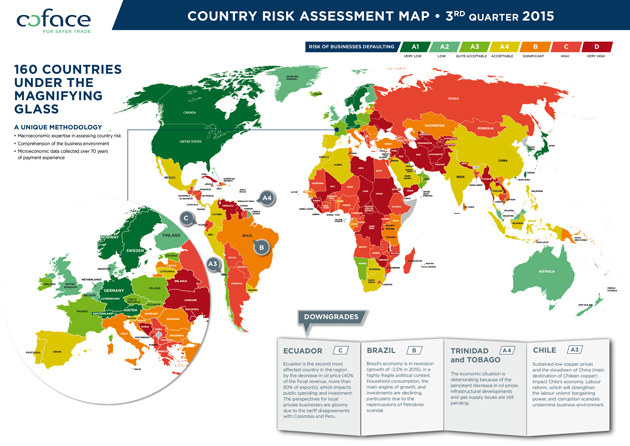
Latin America (forecast of a 0.2% recession in 2015) underwent a new wave of downward revisions in assessments.
   - Brazil, placed under negative watch by Coface in March, has been
     downgraded to B.
Its economy is in recession (-2.5% growth forecast for 2015), in a context of increased political instability. Household consumer spending, the main driver of growth, and investment both fell, notably given the repercussions of the Petrobras affair.
   - Ecuador, also under negative watch since March, has seen its
     assessment downgraded to C. This country is the second
     hardest-hit by the fall in the price of oil (40% of budget
     revenues, over 50% of exports), which is having an impact on
     public spending and investment. The prospects for local private
     companies are looking worse, due to tariff disagreements with
     Colombia and Peru. The economy is highly dependent upon Chinese
     capital, from whom loans are secured through the award of mining
     concessions, oil revenues and future electricity production.
- Chile, whose assessment has been downgraded to A3, is suffering
from the sustained fall in copper prices and the slowdown in
China (the main destination for Chile's copper). Corruption
scandals are destabilising the business environment. - Having recovered from recession in 2012 and enjoying a
favourable business climate, Trinidad and Tobago, now with an
assessment of A4, is suffering from the negative effects of the
continuing low oil prices. One other problem persists: the
development of gas supplies and infrastructure.Contact:
Christian BENROS T. +41 (0)43 547 00 24
christian.benros@coface.com