
Schweizerischer Nationalfonds / Fonds national suisse
Grasses, forbs and trees: mapping how forests and meadows have changed in 60 years
- Informations
- Download
Bern (ots)
European researchers have analysed almost 650,000 historical data records on biodiversity. The results highlight long-term changes. Most noticeable is an increase in nitrogen-loving plants such as stinging nettles.
Acid rain, over-fertilisation, hot summers - the living conditions for plants in Europe have undergone major changes in recent decades. So far, however, a comprehensive overview of the effect this has on biodiversity has been lacking.
"If you only pick out a few pieces of data from the last 20 years, you can quickly come to false conclusions", says ecologist Jürgen Dengler, who is funded by the SNSF as part of the National Research Programme "Biodiversity and Ecosystem Services" (NRP 82). He and his team at the Zurich University of Applied Sciences (ZHAW) have been involved in an international study that is now closing this gap.
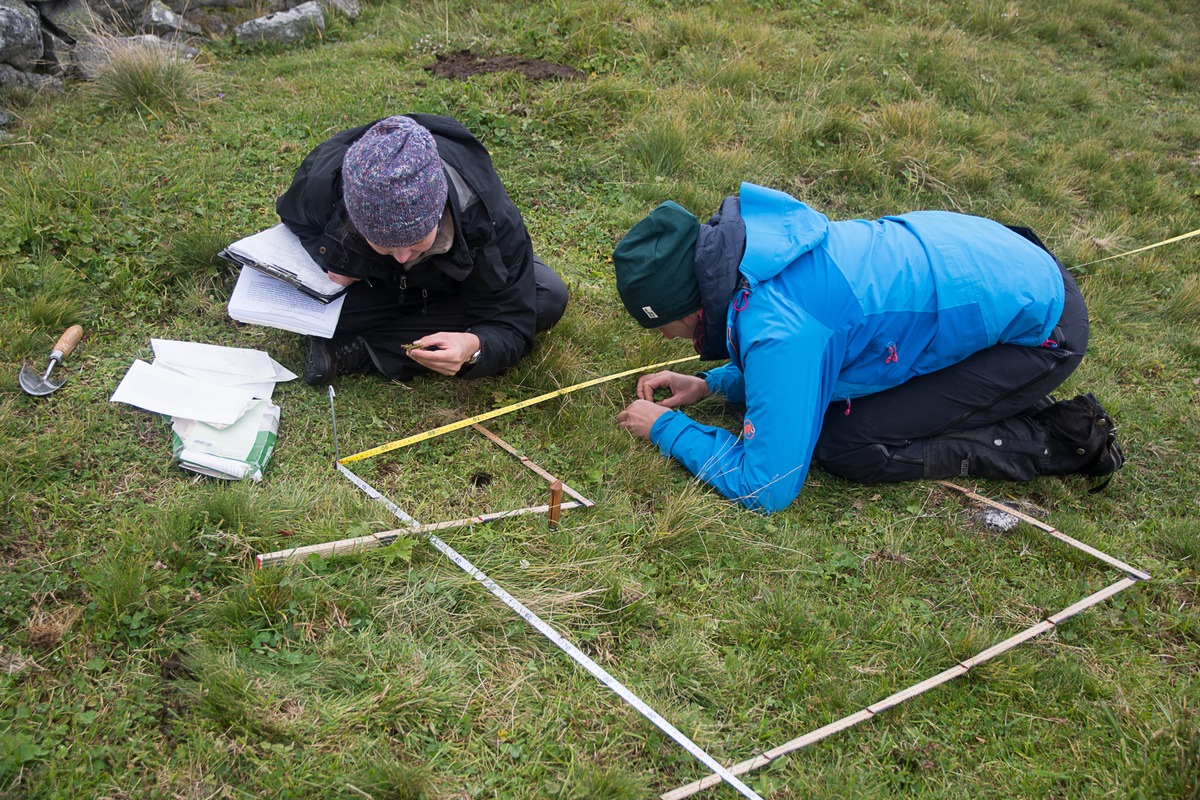
The analysis was based on a vast database, the European Vegetation Archive (EVA). This contains the results of over two million surveys that were carried out for research purposes or nature conservation projects, for example. Such records of plant species and their abundance on defined sample areas, typically between one and 400 square metres. Everything is counted, from tiny seedlings and daisies to 30-metre-high beech trees.
The European team used 650,000 of these surveys, which were carried out between 1960 and 2020, to produce a temporal analysis for the first time. For most of these areas, no information was previously available on factors such as nutrients or light conditions, i.e. whether the soil contains a lot of nitrogen or whether a dense canopy shades the forest floor.
The project team therefore reconstructed this information on the basis of the occurrence of so-called indicator plants that favour certain environmental conditions. One such example is the dandelion, which thrives particularly well on nitrogen-rich meadow soils. "For the project, we developed a common European consensus system for the first time from over 30 different systems for categorising indicator plants", says Dengler.
Artificial fertilisers, transport and industry are problematic
With the help of AI, the researchers then analysed the data that had been collected over decades. This enabled them to determine the composition of plant communities over 60 years in four different habitats - forest, grassland, scrub and wetland. And to gauge what has changed in this time. The indicator plant system then helped to link these new developments with a change in environmental conditions.
One trend stood out: there are more and more nitrogen-loving plant species in all habitats, such as the stinging nettle in forests and the broad-leaved dock in grassland. The cause is obvious. Artificial fertilisers and livestock farming as well as nitrogen oxides produced by transport and industry are causing an increasing amount of nitrogen to accumulate in the soil. The increase in such species is a problem because they displace plants such as orchids, which favour poor soils.
The good news for local biodiversity is that current studies show that this trend is showing a slight decline in Switzerland. "It seems that regional measures such as the reduction of artificial fertilisers are having an impact here. But there is still no sign of this across Europe", says Dengler.
Additional effects only occurred in certain habitats. The indicator values in grassland are shifting towards shade-loving species - possibly because the vegetation is becoming increasingly dense across Europe due to nutrient inputs or a lack of management. According to Dengler, in places such as eastern Europe, there are huge fallow lands due to socio-economic factors. This overgrowth means that less light reaches the ground. Small-growing, sun-loving species such as thyme and cowslips therefore have less chance of thriving.
Temperature effects unexpectedly low
One result was rather surprising: "Vegetation reacts much more slowly to temperature increases than we would have predicted", says Dengler. The native species have therefore not yet been significantly displaced by heat-loving plants from southern countries or other continents.
One explanation for this is that these species do not normally live in close proximity to each other and have to travel long distances to colonise - either by spreading via seeds or as stowaways during the transport of goods. The expected effect may therefore lag behind the rising temperatures.
The Swiss mountains are an exception. In recent years, it has been proven that more and more heat-loving species are moving up to higher altitudes. These include typical lowland grasses such as English rye grass and meadow foxtail. They do not have to travel long distances to do so, but simply move their habitat upwards by a few metres - which is why this development may already be detectable.
Over the next few years, Dengler will carry out analyses specifically for Switzerland as part of the SNSF VegCHange project. He wants to document the changes in a fine grid of around 100 square kilometres - the international research work covered around 25,000 square kilometres: "We actually have more data than anywhere else. It's just not yet available in a central database."
The results are to be prepared for use in practice. Stakeholders, for example from policymaking or nature conservation, can contribute additional research questions or requests for data processing. This is initially taking place in Graubünden, where there is data on diverse landscapes ranging from farmland and moors to larch forests. Other cantons are to be added gradually.
"In this way, we can find out where the greatest species losses are occurring in Switzerland and then adopt the right strategy to tackle them", predicts Dengler. And this analysis will probably also highlight where biodiversity is at a good level and where maintaining the current status is sufficient.
The text of this news and further information are available on the website of the Swiss National Science Foundation.
Contact:
Jürgen Dengler
ZHAW Life Sciences and Facility Management
Institute for Environment and Natural Resources
Grüentalstrasse 14
8820 Wädenswil
Phone: +41 (0) 58 934 50 84
Email: juergen.dengler@zhaw.ch