swissstaffing - Verband der Personaldienstleister der Schweiz
Swiss Staffingindex: disappointing year for staffing service providers
- Bild-Infos
- Download
Ein Dokument
Dübendorf (ots)
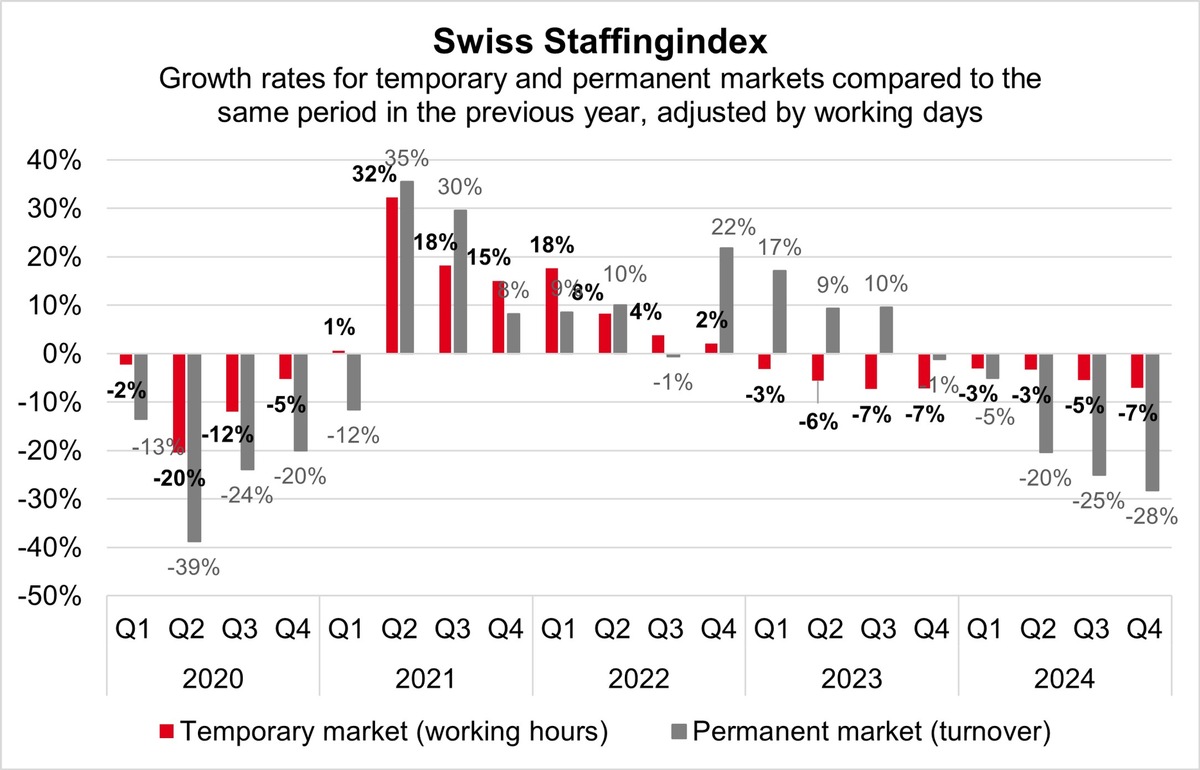
Economic downturn, skills shortage and market structure: for the first time in 30 years, the temporary staffing sector has shrunk two years in a row. The permanent staffing sector fell by 19,4 percent - to its lowest level since the Swiss Staffingindex was created.
A weak economy, a skills shortage and structural change all posed major challenges for staffing service providers in 2024. Turnover in the permanent staffing sector was down 19,4 percent on the previous year. Working hours in the temporary staffing sector also fell by 4,7 percent. This sector was already in the red in 2023, having dropped 5,8 percent compared with 2022. Companies are being cautious about creating new jobs due to the uncertain outlook for the future. External staff are increasingly being recruited via partnerships with selected staffing service providers and temporary workers are being incorporated into the permanent workforce more quickly. This market situation poses economic and strategic challenges for staffing service providers.
After a disappointing 2023 for the temporary staffing sector (with a drop of 5.8 percent), the downward spiral seemed to be slowing in early 2024. The market then went downhill again in the second half of the year, by 5,4 percent and 7 percent respectively. This development is due to the fact that the factors causing the downturn have changed over the last two years. Whilst the 2023 decline was down to a historically high skills shortage, in early 2024 the economy began to slow and the labor market began to normalize. Companies experienced increasing uncertainty and pressure to make savings during the second half of the year, making them correspondingly cautious about recruitment - even of temporary workers. The market slumped. This development is even more evident in the permanent staffing sector, where the growth rate has been declining for nine straight quarters. Whilst the fourth quarter of 2022 was up 21,8 percent on the previous year, the market fell by 28,2 percent in the fourth quarter of 2024. Pressure on companies to make savings has also sped up structural change in the sector. Companies are using AI to make their HR more efficient and incorporating temporary workers into their permanent workforce more quickly. In addition, an increasing number of companies are structuring collaborations with staffing service providers in the form of tenders. This development is forcing staffing companies into strategic reorientations, innovations and increased efficiency.
Staffing service providers in the context of the economy and strategic positioning
Balz M. Villiger, Country Manager Gi Group Switzerland, puts the market situation in a nutshell: "Areas that have jobs have no applicants, and areas that have applicants have no jobs." He reports that numerous jobseekers apply within a single week in response to job advertisements for HR or marketing professions, and the traditional application process is still working in these areas. For understaffed professions such as cybersecurity or trades, talented individuals have their pick - generally with excellent terms. These applicants set as much store by flexibility as they do by salary. Staffing service providers' success is heavily dependent on the market conditions and demand: "We have been seeing declines in logistics and industry since 2023 due to the economy, now the bottleneck is particularly in specialist professions," Villiger notes. Providers who focus on specialist areas and are able to identify suitable profiles, including on social media, stand out from the pack.
In the current market situation, even focusing on specialist professions is no guarantee of security for staffing service providers. Figures from Lightcast, an international labor market monitoring specialist, show that the number of job advertisements in Swiss staffing service providers' core business saw a clear drop in 2024 - down 24 percent in industry, 18 percent in the construction sector, and a surprising 11 percent in IT. Iris Gallmann, CEO of auticon Swiss AG, tells of a difficult year. Her company provides teams of autistic IT specialists with specific strengths to support clients' project teams. The surprising drop in IT demand posed major challenges for auticon Swiss AG in 2024. Gallmann says: "To remain an attractive partner for our clients, we had to strategically reorient ourselves and consider which IT profiles are still in demand in Switzerland and where clients are turning to automation or making use of foreign contracts." Gallmann expects this strategic reorientation to bear fruit in 2025. This would be aided by an upturn in the economy.
Cautious outlook for 2025
The labor market's trend towards normalization is likely to continue. Excess production capacity, weakening economies in neighboring countries and China, and a lack of skilled specialists are all putting the brakes on things and creating challenging market conditions. These are paired with new risks such as protective tariffs from the incoming US government. The CEOs of swissstaffing's members remain cautious. A flash poll conducted by gfs-zürich on behalf of swissstaffing showed that after two years of decline, 40 percent of CEOs are expecting business to stagnate and almost a quarter are even anticipating further drops. However, 33 percent are expecting to see moderate market growth in 2025.
For more information, please contact:
Dr. Marius Osterfeld, Head of Economics & Politics
Tel: 044 388 95 70 / 079 930 45 25
marius.osterfeld@swissstaffing.ch
Celeste Bella, Head of Marketing & Communication
Tel: 044 388 95 65 / 079 388 94 22
celeste.bella@swissstaffing.ch
www.swissstaffing.ch