New Scientific Publication: Scientists Call for the Protection of the Solitary Dolphin “Mimmo”
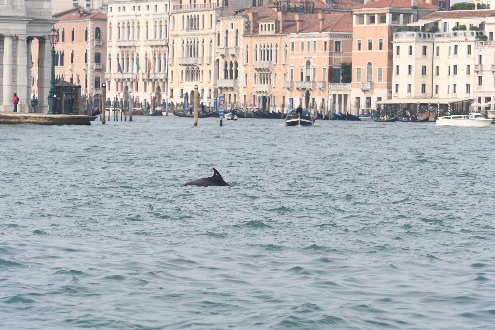
- Bild-Infos
- Download
Eight Months in Venice: Scientists Call for the Protection of the Solitary Dolphin “Mimmo”
PRESS RELEASE – 25 February 2026
For eight months, a solitary bottlenose dolphin (Tursiops truncatus) has been residing in the Venetian Lagoon—adjacent to one of Europe’s most visited urban settings. A newly published scientific study warns of significant risks arising from vessel traffic and close human approaches, and calls for clear protective measures as well as responsible public conduct to safeguard the dolphin’s survival.
Venice, one of the world’s most popular tourist destinations, has recently had a special visitor – a bottlenose dolphin – that has spent the past eight months in the waters of the Venetian Lagoon, often swimming close to the iconic San Marco Square. Conservationists have been concerned about potential harm this dolphin may face due to increased public interest and similar cases often resulting in the death of the animal because of human misbehaviour.
A new scientific publication calls for protection for “Mimmo”, the solitary dolphin who has taken up residence in the busy Venetian Lagoon, urging the public to follow official guidance to ensure human-wildlife coexistence and prevent disturbance or injury to the dolphin. The new paper published today in Frontiers in Ethology describes the dolphin’s behaviour and outlines the risks it faces living in a busy area where boats and curious onlookers frequently approach, attempting to catch a glimpse of this special marine mammal. The paper’s authors call for people to comply with Italian and international legislation to keep the dolphin safe as well as recommending the development of a specific action plan for the dolphin.
Atypical Prolonged Residency
Bottlenose dolphins are present in the Adriatic Sea, but it is unusual for them to enter the Venetian Lagoon, and it is even more unusual for them to stay there for a prolonged period. “Mimmo” was first recorded in June 2025 and is still present eight months later. Researchers from the University of Padova and the Natural History Museum of Venice have been monitoring the dolphin and report that it is healthy and feeding well, taking advantage of abundant mullet in the Lagoon waters close to Venice.
To reduce disturbance and the risk of injury, the team from the University of Padova developed a code of conduct specifying that boats should maintain a distance of at least 50m from the dolphin, avoid accelerating, changing direction abruptly or reversing and that speed limits should be adhered to. People are told not to approach, touch, feed or throw objects towards the dolphin.
First Injuries Documented
Despite these measures, reports indicate that guided tours have approached the dolphin, and individuals have tried to feed or touch it. In November, the dolphin was sighted with injuries consistent with a possible boat propeller strike. Authorities subsequently attempted to encourage the dolphin to leave the San Marco Basin; although the intervention appeared to work initially, the animal returned to the basin shortly afterwards.
Heightened Vulnerability of Solitary Dolphins
Laetitia Nunny, Senior Science Officer at OceanCare, who has written extensively about solitary dolphins – particularly so-called “solitary-sociable” individuals that interact with humans – welcomes the authors’ findings and warns that such animals can be especially vulnerable: “Solitary-sociable dolphins are often at greater risk of vessel collisions because they spend extended periods close to people and boats. At about the same time that the Venice dolphin was first reported, a long-term solitary-sociable dolphin known as “Confi” died in Spain due to a suspected propeller injury. We hope that the efforts of Italian scientists and the Venetian authorities will prevent a similar outcome here.”
Protection Through Coexistence Rather Than Displacement
The authors also assessed the feasibility and the ethical implications of potential interventions to displace the dolphin, including the use of acoustic deterrent devices, or capture and translocation. However, they largely dismissed these measures and concluded that the most appropriate strategy is to accept the presence of the dolphin and prioritise protective measures and education of the public about how to behave around a wild marine animal.
Lead author Giovanni Bearzi, a renowned Italian marine biologist whose work has long been supported by OceanCare, emphasises the broader context: “The dolphin in the Venetian Lagoon is trying its best to survive in challenging conditions. The northern Adriatic Sea is heavily overfished, and its habitats are degraded. It is not surprising that the lagoon waters around Venice, where prey is abundant, can attract a hungry dolphin. Now we must learn to coexist, rely on good management practice, and come to view this wild creature with the wonder and respect it deserves.”
Media contact
- Laetitia Nunny, Senior Science Officer, OceanCare: lnunny@oceancare.org
Additional Information on the Article Published in Frontiers in Ethology:
Article title: Case Report: The ‘dolphin of Venice’: management of a solitary bottlenose dolphin in the Venetian Lagoon
Authors: Giovanni Bearzi1,2, Sandro Mazzariol3, Luca Mizzan4, Giuseppe Notarbartolo di Sciara5, Marco Bonato3, Luca Ceolotto3 and Guido Pietroluongo3
¹ Dolphin Biology and Conservation, Cordenons, PN, Italy
² OceanCare, Wädenswil, Switzerland
³ Department of Comparative Biomedicine and Food Science, University of Padova, Padova, Italy
⁴ Natural History Museum Giancarlo Ligabue, Venice, Italy
⁵ Tethys Research Institute, Milan, Italy
Citation: Bearzi G, Mazzariol S, Mizzan L, Notarbartolo di Sciara G, Bonato M, Ceolotto L and Pietroluongo G (2026) Case Report: The ‘dolphin of Venice’: management of a solitary bottlenose dolphin in the Venetian Lagoon. Front. Ethol. 5:1770678. doi: 10.3389/fetho.2026.1770678
;> ;> ;> High-resolution images are available here. The corresponding image credits are indicated in the respective file names.
Further Information
For more information about solitary-sociable dolphins including other scientific papers detailing their numbers, locations and recommendations for their management:
- OceanCare: Solitary Dolphins Risks and Responses
- Scientific Publication: Nunny L and Simmonds MP (2019) A Global Reassessment of Solitary-Sociable Dolphins. Front. Vet. Sci. 5:331. doi: 10.3389/fvets.2018.00331
---
OceanCare, Gerbestrasse 6, CH-8820 Wädenswil
Tel +41 44 780 66 88, presse@oceancare.org, www.oceancare.org
Folgen Sie uns:
 Twitter
 LinkedIn
 Facebook
 Instagram